

← Results/Mobility · Behavioral Modeling · 2025
Swiss Federal Railways (SBB)
68 Behavioral Parameters of Swiss Worker Schedule Flexibility
Maximum-likelihood estimation on 10,110 real microcensus schedules, the empirical calibration any activity-based travel-demand model can drop in instead of guessing
68 / 68
behavioral parameters estimated from real data, every one significant at 5%
10,110
real Swiss microcensus schedules in the calibration sample
Transportation · Springer
peer-reviewed and open access (CC BY 4.0)
~1 hour
to simulate 50,000 Lausanne worker schedules on a 48-core server
When two activities collide on someone's day, which one moves? Does a Swiss commuter stretch lunch or shorten work? Will they push leisure later, or skip it? Until now, transport models filled in those numbers by guesswork.
We worked with SBB and EPFL on the published journal paper that pulls them straight from data. The result is an empirical, peer-reviewed answer to how flexible each part of a Swiss working day really is, and the foundation for SBB's behavioral calibration of SIMBA MOBi.
The problem
Existing activity-based models pick one flexibility coefficient per activity type, by hand. That can't capture that workers stretch lunch but rarely move their work block, or that shopping is more flexible than picking up a child.
SBB needed parameters grounded in observed Swiss behavior, estimated rigorously enough to defend a published model, and tractable enough to run in their full-population simulations.
What we built
We treated flexibility as a vector of coefficients in a utility-maximizing MILP and estimated them by maximum likelihood against 10,110 cleaned schedules from the Swiss Mobility and Transport Microcensus, using the standard logit framework on a competitive choice set per individual.
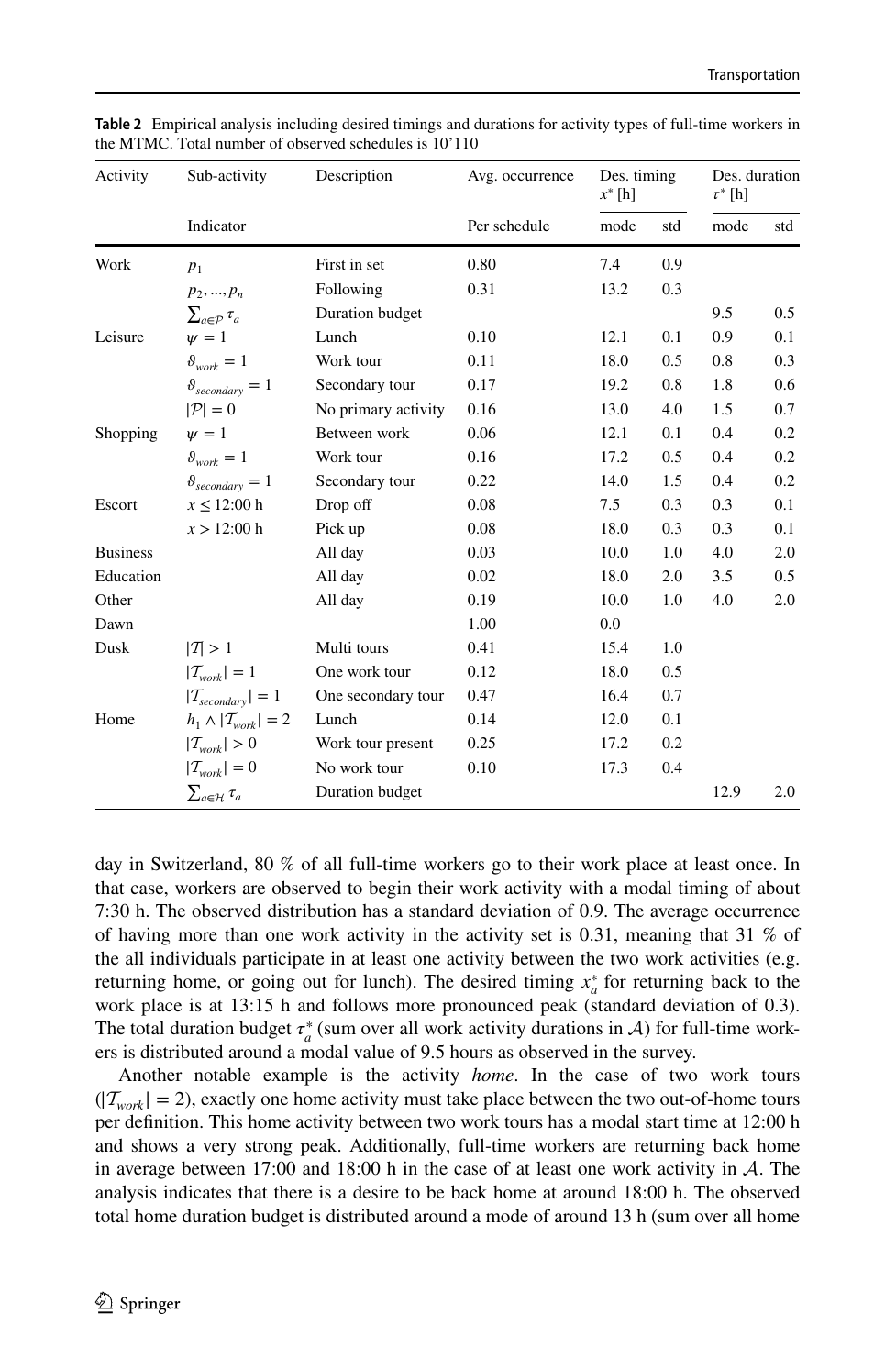
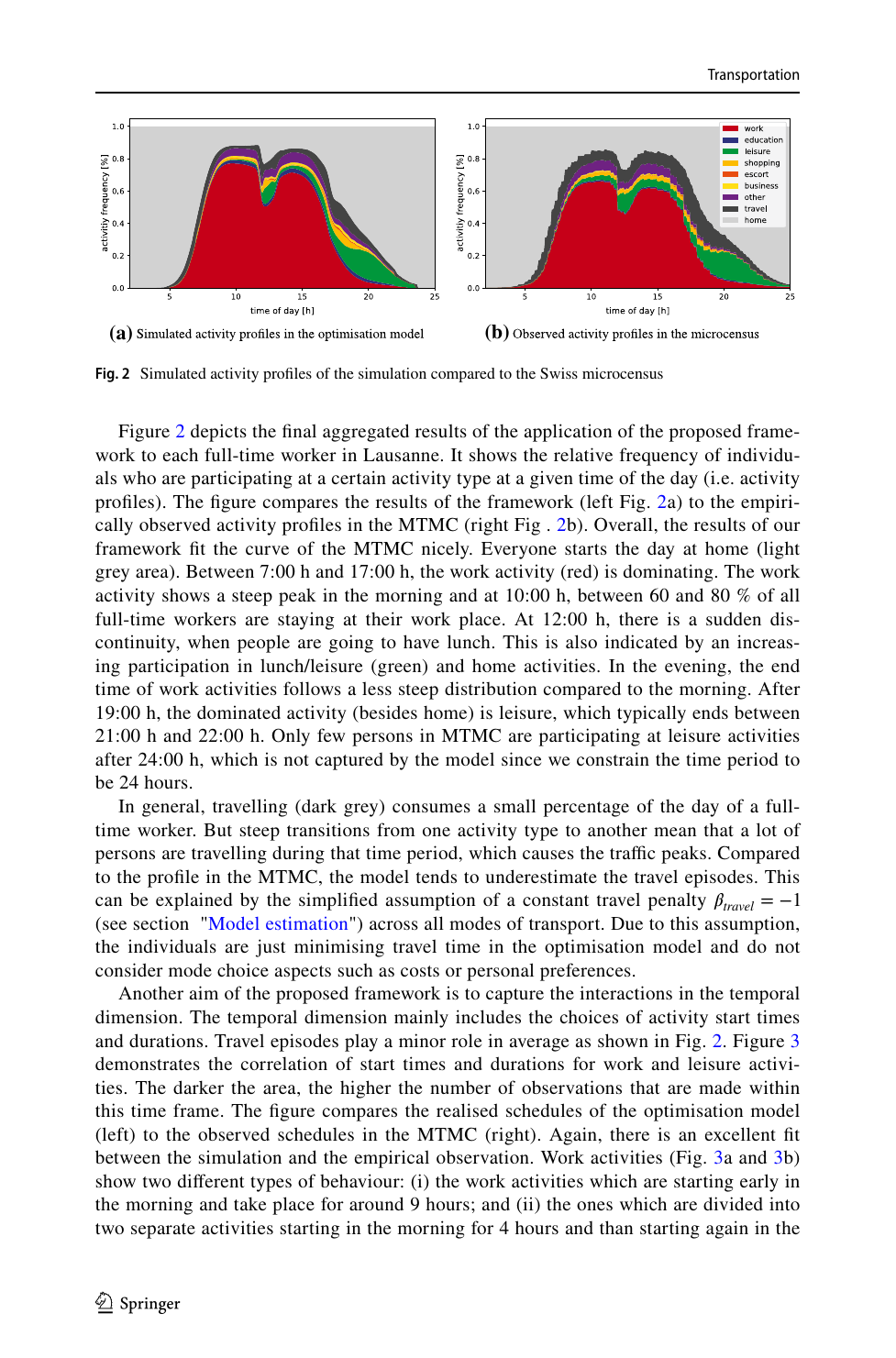
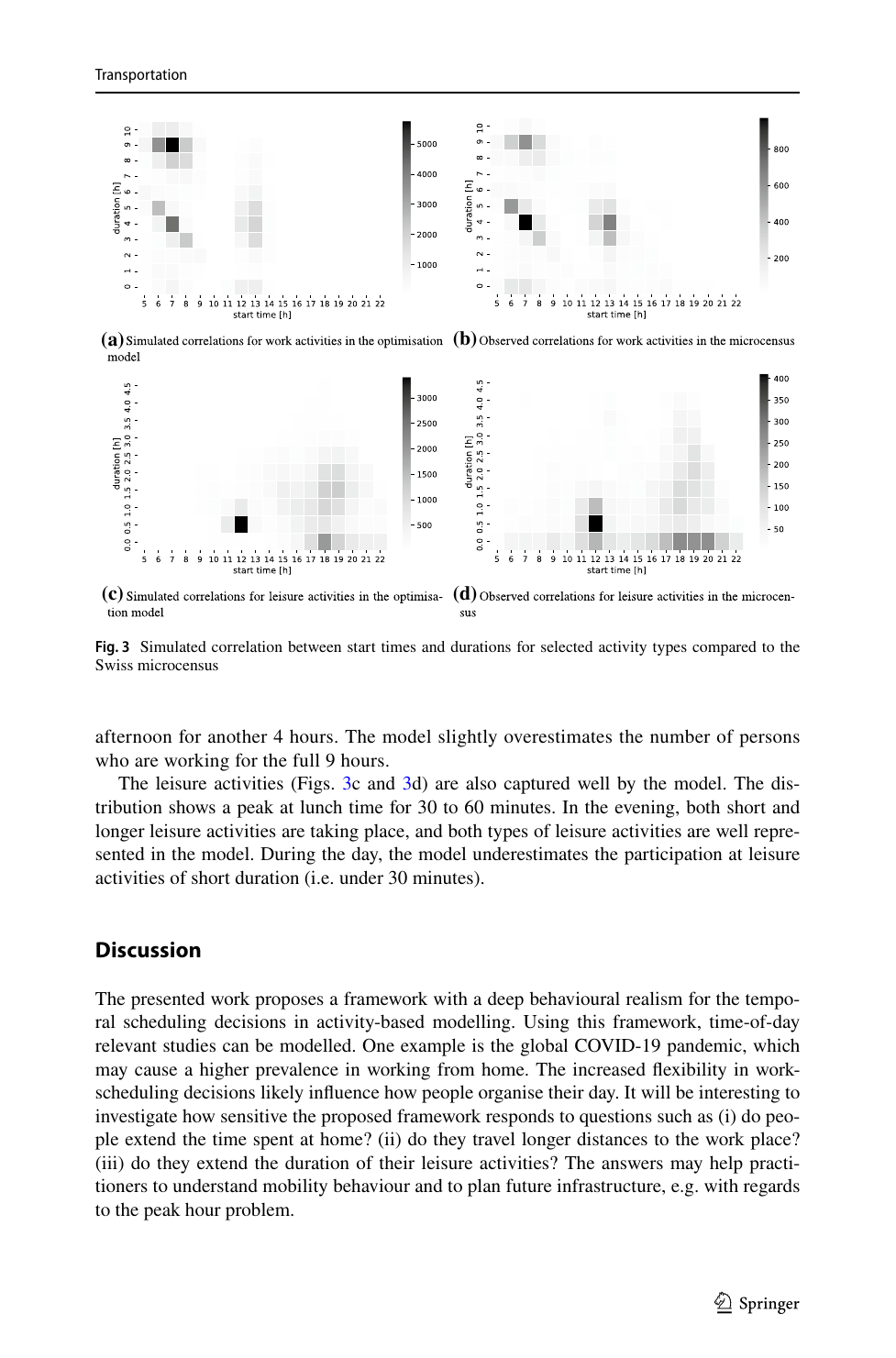
We validated by running the estimated parameters back through the MILP for ≈ 50,000 full-time workers in Lausanne and comparing the simulated activity profiles against the empirical microcensus.
The result
Deliverable: a published, peer-reviewed empirical calibration of Swiss worker schedule flexibility, 68 statistically-significant behavioral parameters that any activity-based travel-demand model can drop in instead of guessing. The framework reaches ρ̄² = 0.154 against the 10,110-schedule sample and simulates ~45,000 Lausanne workers in roughly an hour on a 48-core server. Published open access in Transportation (Springer), CC BY 4.0.
The behavioral picture is sharp: lunch is by far the most rigid activity in a Swiss worker's day (β^short = −7.61, roughly 350× more sensitive per hour to a short lunch than to a short workday). Morning work has a tight start-time target around 7:30, home-after-work pulls strongly toward 18:00, and evening leisure absorbs the residual flexibility. These are exactly the patterns travel-demand models need to calibrate against, but until now they were entered by hand instead of estimated from data.
Technical deep dive
The model behind the result.
The model
The total utility of a candidate schedule is decomposed into per-activity penalties for missing the desired start time and duration, plus a travel disutility on each leg. Each penalty is asymmetric: being early can hurt more or less than being late, and the same for duration.
Total schedule utility. Secondary activities are penalized individually; primary and home activities share a daily duration budget.
Asymmetric piecewise-linear penalty around the desired start time x_a*. β^early and β^late are the parameters we estimate.
Mirror penalty around the desired duration τ_a*. β^short and β^long are estimated per activity cluster.
Logit choice probability over the choice set C_n for individual n, and the maximum-likelihood objective over the realized schedule i*_n. Estimation runs in PandasBiogeme.
The estimator returns a single vector β̂ ∈ ℝ⁶⁸ that captures, in a single statistically defensible language, how rigid each cluster of activities is in a Swiss full-time worker's day.
Benchmark
Estimated flexibility preferences for selected activity clusters (Table 3 of the journal paper).
| Activity / cluster | β^early | β^late | β^short | β^long |
|---|---|---|---|---|
| work : first in set | −0.518 | −0.401 | - | - |
| work : following | −0.317 | 0 | - | - |
| work : daily duration budget | - | - | −0.022 | 0 |
| leisure : lunch | −1.587 | −0.760 | −7.614 | −1.314 |
| leisure : evening secondary tour | −0.058 | 0 | −3.087 | −0.693 |
| shopping : in a secondary tour | −0.229 | −0.468 | −6.003 | −0.746 |
| escort : drop off | −1.106 | 0 | 0 | −4.171 |
| home : lunch | −2.189 | −1.067 | - | - |
| home : with work tour present | −0.072 | −0.397 | - | - |
| home : daily duration budget | - | - | 0 | −0.373 |
Negative numbers are utility penalties per hour of deviation; 0 indicates the parameter was not significant at 5%. The strongest pattern: lunch is highly rigid (β^short = −7.61, workers really do not want a short lunch), and the home-at-lunch return is even stiffer than work itself. Morning work is twice as rigid as afternoon work in start time. Evening leisure absorbs flexibility. Sample size 10,110 cleaned full-time-worker schedules, 68 parameters all significant at 5%, ρ̄² = 0.154, log-likelihood improvement −57,443.43 → −48,548.23, estimation time ≈ 12.3 h on 40 cores.
From the record
Techniques
- Maximum-likelihood estimation under a MILP simulator
- Choice-set construction (likely + random alternatives)
- Logit choice models on schedule alternatives
- Continuous-time scheduling with piecewise-linear utility
- Validation via simulated activity profiles and 2D heatmaps
Stack
- Python
- PandasBiogeme
- OR-Tools
- SCIP
- Ray (parallel execution)
- Swiss MTMC microcensus
A problem like this?